The World Leader in Seismic Protection
We've supplied 28,000 isolators to more than 500 projects across 24 countries. Hospitals stay open, bridges hold, and critical infrastructure keeps running during an earthquake and after it.
Designed so the building keeps working, not just standing.
Conventional design prevents collapse but accepts heavy damage. Isolation protects the people inside, the equipment, and the day-to-day operations, so the building is usable the day after an earthquake.
Decoupled from the ground
Flexible isolators absorb the earthquake's energy at the base, so much less acceleration ever reaches the structure or its contents.
Up to 75% lower foundation forces
On bridges, smaller foundations translate directly to less concrete and steel. The Patria Aqueducto saw a 3.5× reduction.
Open the next morning
USC Hospital stayed open through the 1994 Northridge earthquake. A non-isolated hospital less than a mile away took $400 million in damage.
Lower lifetime cost
When DIS joins from the concept phase, total project cost can drop by up to 30% compared with conventional design.
Tested by real earthquakes
More than 10 DIS-isolated projects went through the 2011 magnitude 9.0 Japan earthquake without damage.
Tested far beyond code
We routinely test bearings to 400% shear strain. R&D runs at UCSD, UNR and SUNY Buffalo. JSSI certified in Japan.
Vertically Integrated Process
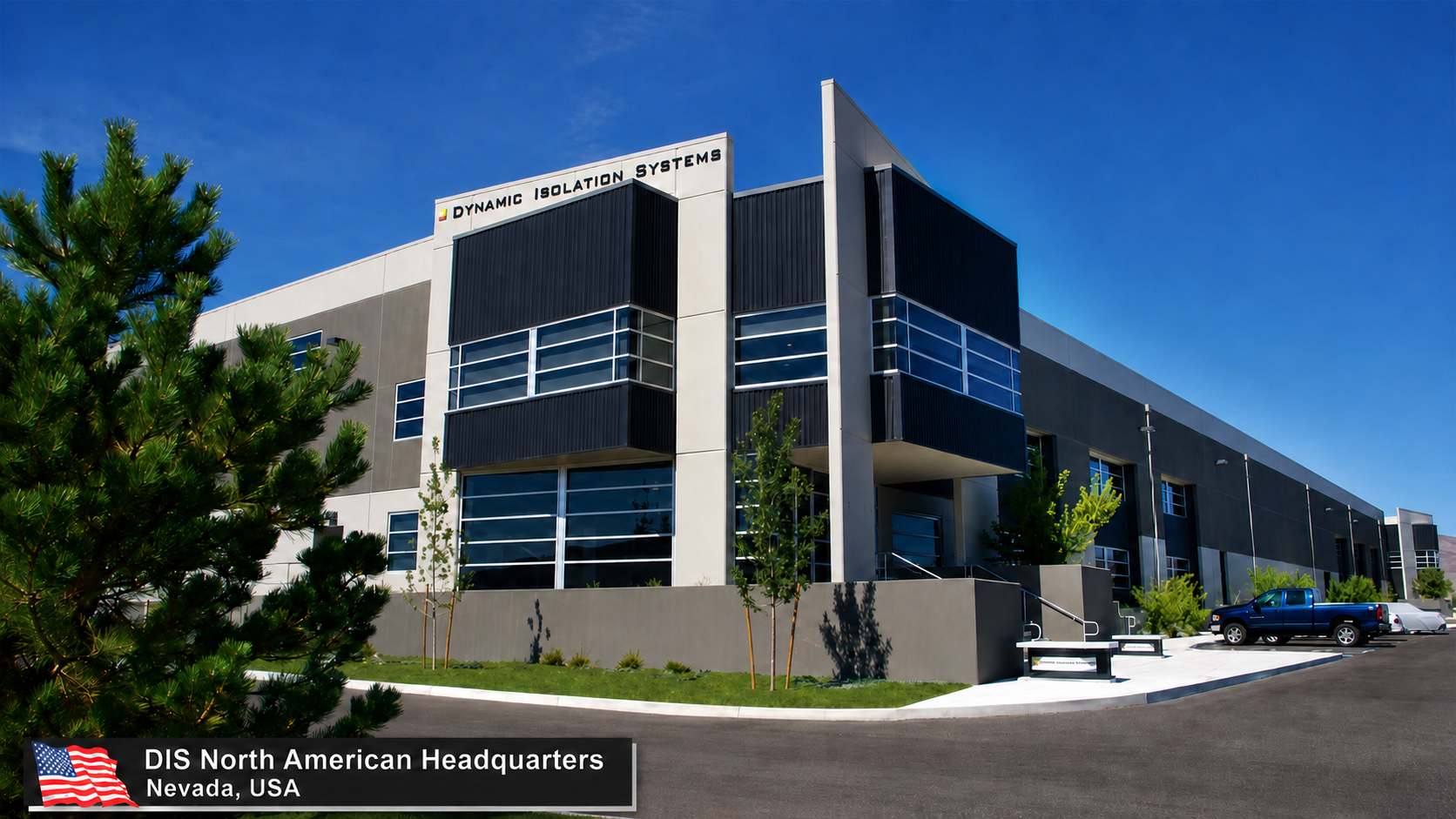
Dynamic Isolation Systems is more than a company that makes bearings to mitigate shock and vibration. From design through manufacturing to testing, everything happens under one roof in Reno, Nevada.
Expert Design Support
We work alongside clients and engineers of record to develop project-specific isolation systems, with guidance on design, material selection, and seismic performance for a safe outcome.
Machining & Fabrication
Our skilled shop handles precise machining and fabrication of every isolator component, holding each part to strict engineering specifications for durability and long-term performance.
In-House Testing
Every isolation system is tested in our plant to validate performance under seismic conditions. Our acceptance criteria meet and exceed the relevant codes.
Proven Resiliency & Reliability
DIS isolators are built for the design life of the structure they sit beneath. Forty-four years of installed history demonstrate the resiliency owners and engineers rely on.
Quality Inspection
Rigorous quality control across every component and assembly. Each isolation system is reviewed and signed off before it leaves the plant for the job site. Our quality management system is ISO 9001:2015 certified.
The track record speaks for itself.
In the 1989 Loma Prieta Earthquake, the three-million-pound Stanford Linear Accelerator sat on DIS isolators and came through untouched. Elsewhere on campus the damage reached $160 million.
In 1992 the Eel River Bridge in California saw 0.55g accelerations in the Cape Mendocino Earthquake. The deck displaced nine inches, the bridge took no damage, and it returned to within a quarter inch of its starting position.
What's been happening at the plant.
Got a project where downtime isn't an option?
Our engineers work alongside you from concept through installation. When we're brought in during the design phase, total project cost often drops by up to 30%.